Throughout my career, I’ve observed a notable tension between the theory of Agile, and the practice of Agile. Some of this is to be expected: Agile ways of working aren’t particularly new and what was once a market differentiator (“we deliver rapidly!”) is now a commodity. Likewise, manifestos and principles are showing their age. It turns out that a bunch of white dudes in Colorado probably didn’t speak for all Agile practitioners then, nor do they now. Thoughts around Agile are evolving, and this is almost certainly a good thing.
Except, of course, when it isn’t. The commoditization of Agile has had some nasty side-effects: Some organizations use Scrum Masters as de facto Project Managers. Large, lumbering frameworks purport to scale inherently lean ways of working. Velocity and Story Points have been abused to the point of incoherence. Everyone seems to know something about Agile, but nobody knows what to do with it.
Indeed, there are struggles in adopting more Agile ways of working that are beyond the tactical. Chris Matts’ post on Failureship captures nicely why Agile often struggles in large organizations and it wouldn’t surprise many to learn that it has a lot to do with culture. Culture, of course, is at the heart of what we preach, but it’s often overlooked because it’s far less tangible than role changes or dashboards, and it takes time – a long time. Few companies want to commit to that sort of transformation.
And so, Agilists have a tough reality to confront: The Agile we want to see implemented in the world, is likely not what will emerge. Regardless of what we want, our customers often want something else. This isn’t to say there aren’t wins to be had, but rather, that the major wins – the mindset shifts, the cultural changes – will take a while to see.
In the meantime, I suggest a dash of pragmatism, or realpolitik: Coach to the reality you see, and identify the impact you can actually have on an organization or individual, not the impact you’d like to have otherwise. As Coaches, our sphere of influence expands or contracts based in part on who we’re working with. Approaching these conversations with pragmatism feels a bit like giving up the high ground, but this isn’t war, or even a battle – it’s a partnership.
In theory, Agile ways of working are no-brainers. In practice, there are corporate hierarchies to work around, HR practices that need to be changed, and habits that individuals needs to let go of. All of this takes expertise to navigate, and patience to change. In a world where there’s a lot of “fake Agile” out there, approaches grounded in reality are a positive next step for the Agile community to take.
A couple of weeks ago I wrote about how aligning on what we call things better enables teams and Leadership to enact change. The upshot was that organizational change can be accelerated (and reinforced) by changing the literal words we use to communicate with one another.
If the words we use when talking to each other matter the most, a close second are the words we use in our documentation and tools. That said, in my last post, I sort of glossed over that:
The team of coaches planning this transition (of which I am one) spoke a lot about tools, processes, documentation, and other very practical things the organization needed to ensure our efforts were compliant with regulatory and operational requirements. There was a lot of conversation about which teams we’d work with, what product lines we’d focus on. We talked a lot about the frameworks we’d be implementing and trainings we’d create to support it.
Feels like there’s a bit of hand-waving there, so let’s be clear: Updating documentation to reflect how we talk about work helps stave off the entropy change presents. Taking the time to change the literal text in the tools we use has a huge impact: It reinforces how we talk and think about transformation and ensures that all entry-points to learning about how we work are put in the context of the wider transformation effort.
A warning about not laying this groundwork: When such efforts are de-prioritized or ignored, inconsistent messaging and duplicitous behavior sometimes follow. Entropy remains high, and the buying into the transformation continues to feel risky, like it’s not “official” or “real.”
The specific language we challenge ourselves to use during a transformation should be applied to all artifacts and tools we’ll use as well. Change doesn’t need to happen everywhere, all at once (we want to remain agile, after all), but it should occur evenly. The more even the shift, the less entropy we’ll have along the way.
Over the past few months I’ve been working with a few Scrum teams to adopt a more Kanban-like approach to getting work done. Their goal is to move closer to an operating model that emphasizes continuous intake and delivery of work. Enthusiasm is high, leadership and management (yes, they’re different) are into it. The groundwork has been laid for a impactful transformation.
Earlier in my career, I would leverage this enthusiasm by aggressively pursuing topic-specific trainings and detailing playbooks for future implementations. I’d be keen to let the teams go at in on their own after just a few weeks – “they have this locked up!” – and I’d work with Scrum Masters only, encouraging them to look at the data and facilitate their discussions about improvement from there. I’d be in and out – job well done.
But today, I am taking a far more methodical approach, one founded on language, taxonomy, soft skills, and culture. I’m using the groundwork laid by leadership as a springboard for cultural change, not just process change. Today, I care less about the actions we’re taking, and more about the language we’re using to express intent and desirable outcomes. Why? Well…
Years back I worked with an Agile Coach who was Very Into Taxonomy. It was his talking point in nearly every brainstorming or planning session:
“How does this Portfolio define ‘in progress’?”
“Do we all know what ‘program means’?”
The questions often hit a nerve, and felt like a huge distraction from the Real Questions (whatever they were at the time.) But in a world where leadership and teams weren’t clear on definitions of things, those questions above were critical to answer. Misalignment and confusion compound over time, and it’s worth putting in some effort up front to make sure we’re all speaking the same language, and hearing the same thing. You learn that fairly quickly when you sidestep defining how you talk about stuff within your team.
OK, Back to the present:
In shifting from Scrum to Kanban, my teams are letting go a couple of comfort zones: Story Points and Sprint boundaries. All of sudden, velocity and burndown charts are not the stars of the show (indeed, they’re gone completely!) And Sprint start and end dates no longer matter, because Sprints are gone too! While the work hasn’t changed at all (same priority, same User Stories), the way we measure and talk about the work has changed. And that takes a bit of level-setting and getting used to before everyone feels comfortable again.
The team of coaches planning this transition (of which I am one) spoke a lot about tools, processes, documentation, and other very practical things the organization needed to ensure our efforts were compliant with regulatory and operational requirements. There was a lot of conversation about which teams we’d work with, what product lines we’d focus on. We talked a lot about the frameworks we’d be implementing and trainings we’d create to support it. And while doing all of this, something happened: We began to realize that what we’re really talking about is changing how we talk about doing work. We’re changing process, yes, but the real impact here is how we communicate progress through that process. All of a sudden spending time getting taxonomy right felt very relevant and very worthwhile.
Transformation can be tackled aggressively, quickly. I’ve done that before, and in many ways it’s thrilling. But the speed of a transformation is governed by how quickly we adopt the new language. And so when implementing something new, it’s critical to measure success, but also consider how you will listen for language as it changes. At the end of the day, you may find that a far more reliable indicator of how your transformation is going.
Of all the home improvements I’ve done, hanging curtain rods is by far the most painful: It’s a whole lot of measuring, a whole lot of making sure things are level, and (at least for me) a whole lot of getting at least one of those things wrong and having to re-drill. Curtains are hard. And yet, curtains are great*! Blackout curtains help the kids sleep better during the day, and they’re super helpful in the summer when the sun sets late in day but bedtime remains the same. The benefits gained by having curtains set up far outweighs the pain it take to set them up, and so it had to be done.
In each of the kids’ rooms are two windows – four total. They’re ~75in. x 36 1/2in. (including trim). A blackout curtain needed to hang over the window such that almost no light made its way through, but a bit of light coming from the sides was fine. The curtains had to be hung such that they didn’t drag on the floor, and were level with the ground (more on this in a bit.) Aesticetically, the curtain rod and dressings had to look good, but only to us parents – nothing flashy needed here.
In previous curtain installations, I’ve sort of winged it when it came to placing the curtain rod. It’s always been level and centered, but because it’s just been a single curtain rod or set perpendicular with the room’s windows, I didn’t worry so much about spacing, height, or making sure all curtain rods hung throughout the house followed a patter. This worked out OK, but such an approach has only contributed to my apprehension about hanging curtains: It doesn’t feel great to wing it when putting so many holes in the wall.
To tighten up the specs here, I searched online and discovered that curtains tend to overhang their windows by about 3 or 4”, and the rod is placed as high as the curtains need to be, given their height. Our curtains (from Costco, naturally), were a standard 84”, and so the rod would be that height.
Let’s shift gears for a second to something more work-oriented: As our company grows (we’re hiring, btw!), processes need a bit of standardization, and templates are a great tool for ensuring that basic information is captured in a way that’s easy to enter, easy to report on, and inherently scalable. Templates are not set in stone, but provide a solid common ground to start from. Additionally, a good template takes time to put together, but that time is saved the more it’s used in the future.
Back to curtains, which, remember, I really don’t like hanging. Given that there were four windows, and they were all the same size (and indeed, are the same size across the house), creating a template for where screws should go seemed to make sense. If it didn’t save me time when hanging stuff up, it would at least kept things uniform. Additionally, because creating a template was something I could do at the kitchen table, I got to spend less time on a ladder juggling multiple tools and more time with my family doing puzzles and coloring. Win/win.
To create the template, I first measured all the things. The 3” on either side was easy enough to remember, but the rod had to hang at a height different than that of the screws used to hold it in place. Additionally, I had to consider what material I’d be using for the template and compensate for any height difference. I started sketching this out:
I elected to use a scrap piece of 1×4 because it was light and easy enough to hold with one hand. Because the 1×4 was taller and longer than it needed to be, and I didn’t want to rip it down to size, I noted which was the top/bottom/left/right. Simple enough, but I’ve messed this sort of thing up in the past and it’s infuriating when it happens. In addition to these Very Obvious Markers, I found the center of the span and made another Very Obvious Note to place the center in the center of the trim of the window. What’s a template without some instructions, right?
Finally, I marked where the brackets would go, pre-drilled some holes, and gave it a test run. Here’s the template in use:
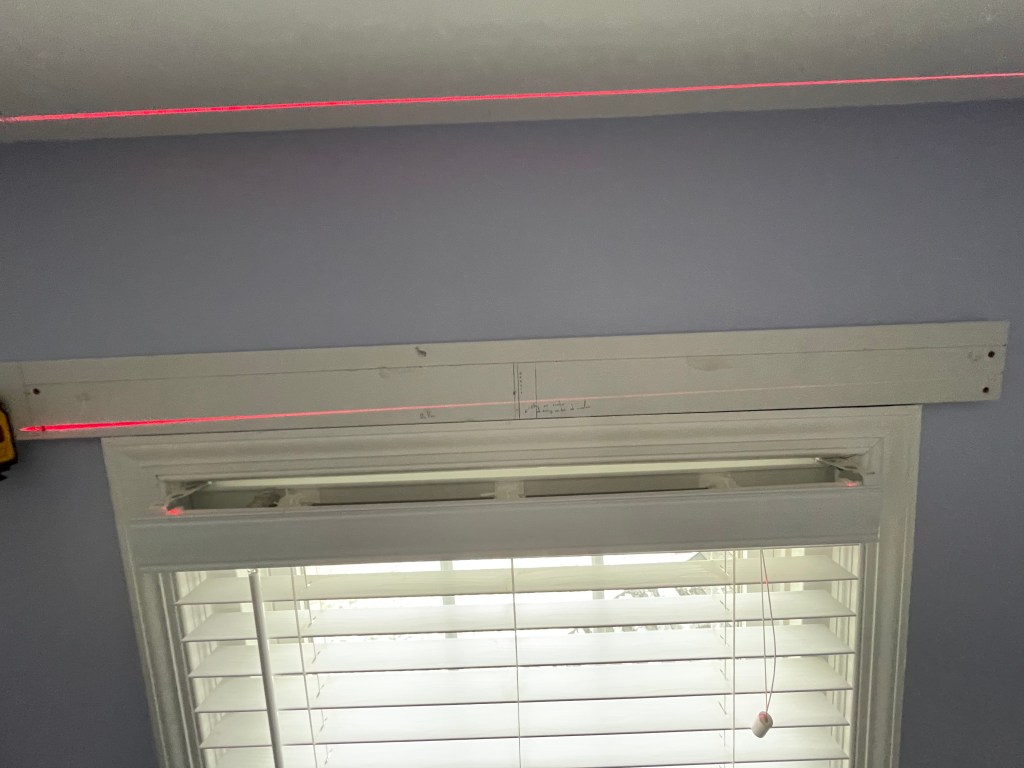
With the spacing in place, it was time to double-check how level everything was. It’s a good thing I did, because the window wasn’t as level as I expected:
To mitigate, I simply levered the template up to ensure the left holes were level with the right, made my marks and went on my way. Without the curtain, the bar would look uneven with the window. With the curtain however, everything looked nice. This was preferable to the opposite effect, had I kept the template true to the casing. (I suspect the culprit of this unleveling is the house settling, though there aren’t any visible signs of stress. Perhaps in the future there will be? Yayy…)
With the rod in place, curtains were hung with ease, and they look pretty good. Most importantly, they look nearly identical, as the template would suggest.
Templates are powerful things – helpful, but customizable when necessary. Spending the time upfront to think through a useful, flexible template was a good investment: It took me two hours to hang four curtain rods, and they all look great. I don’t think I’d change much of the template, except to maybe triple-check how align the screw holes were with each other, but for now it has graduated from scrap wood to useful tool.
*Curtains are mostly great, but in general I’m not a fan. They’re good in the kids’ rooms but otherwise I find them drab and a bit imposing. Still, a well-placed window dressing can really make a room and I hesitate to say all curtains are bad. #TeamBlinds though unless you can convince me otherwise.
2021 hasn’t really started the way I hoped it would: At a macro-level, it feels like 2020 hasn’t quite given up. On an individual level, I’m feeling burnt-out, tired, and distracted by current events. The “holiday break” – a time when most take vacation and refresh for the new year – never really happened. Instead, with nowhere to go, I stayed online and got work done. Productivity peaked just before the new year, but now I’m feeling stretched thin and overwhelmed. Another pandemic “wall”, if you will.
Context switching and feeling overwhelmed isn’t just an individual thing – I’ve seen it in teams too. Analysis paralysis, miscommunication, and backlog churn are all endemic to teams that are being asked to do too much, or that haven’t had enough time away from fighting fires to look ahead (and plan accordingly.) But there are solutions to some of these challenges, and indeed there are ways leaders can step and help their teams shift into high-gear.
Analysis paralysis occurs when there are too many options to pick from, or the options to pick from are indistinguishable in a meaningful way. It causes teams to bicker over nuance, dive into the weeds to discern some type of difference, and get lost in the what-ifs and so-whats. How to remedy? Lean on your Product Owner (or Manager). Have facilitated, timeboped brainstorming sessions. Say “No” to ambiguous requests and unclear value propositions.
Miscommunication is another symptom of teams being overwhelmed. The more we have to juggle, the more likely it is that our notes will be wrong, or that we’ll forget to explain something. Indeed, teams working with different stakeholders on different initiatives will find that managing those lines of communication becomes a full time job. An easy way out of this is to lean heavily on your Scrum Master or Program Manager. I say this with a natural bias, but we’re here to help, and are often trained in listening, facilitating, and ensuring communication stays tight and on topic. Ensuring understanding early and often helps reduce miscommunication down the road. Confirming what was heard and replaying what was said (as you understood it) drives shared understanding and alignment, reducing future (or further) friction and churn.
Finally, we have backlog churn. This is the classic “we working on this thing, and now it’s changed to that thing.” Stopping work midway to take on something else is almost always wasteful. The tech debt alone would score a good Scrum Master into action, but the real power player here is the Product organization. Product ultimately owns the backlog, with some “with the teams’ guidance and alignment” thrown in there for good measure. The less churn there is in the backlog, the more focused people doing the work can be. (Of course, it’s good to have other things to work on should team members be blocked, but ideally they’re not blocked for long. Looking at you, Scrum Masters.)
A stable backlog, a healthy team culture, and strong Product and Program leadership can help teams navigate tough times. So far, 2021 is proving just as challenging as 2020. It’s critical that we, as leaders, understand how that’s impacting our teams, and respond decisively.
About a month ago I crossed a fun milestone: I had completely filled my Apple Watch rings for 365 days in a row. This was not an easy feat, but such repetition does become a bit programatic. When I close them on New Year’s Eve, every day in 2020 will have seen me go out of my way to stand, move, and excise to “close my rings” (a phrase heard regularly in our household.) Not too shabby!
As a reward for filling rings multiple days in a row, Apple Watch gives me a Longest Move Streak badge. The streak is now at 396 days, and should it be broken, it’ll be difficult to beat in the future. As it were, I’ve discovered that such a streak has a rate of diminishing returns: It’s great to see you can do something for a week, a month, a year. But more than? At some point, it feels like goal posts should be moved, comfort zones widened – change up the program a bit.
If 2020 was all about practicing staying fit – getting used to commitment and physical stress – than 2021 will be about playing in that space a bit. I intend to bump up the Move goal (from 690 calories to probably 900 or so) and expect to break the year-long streak I have going. I’ll keep the Stand and Exercise goals, as I achieve those regularly anyways (thanks to my kids and the dogs), and there’s no further room to adjust upward. I’ll lean heavily into Apple’s Fitness+, and not just because I’m already paying for it: It’s actually really, really good!
Exercise – activity of any kind, really – is core to 2021’s theme of Investment. But this isn’t about trying to only fill rings: 2021 will be about enjoying exercise, doing activities I find fulfilling. Sometimes that will mean I run on the treadmill for an hour staring at my basement wall (a good way to actually disconnect from reality for a bit and listen to new music.) Sometimes that will mean hiking or taking a walk around the block with my kids. Filling rings won’t be the reason I exercise next year, enjoyment will be. I expect this will change the relationship I have with fitness for the better.
In the Agile community (of course there’s an Agile hook here), a concept called “Shu Ha Ri” (borrowed from Aikido philosophy) is employed to describe the process of learning. As Martin Fowler notes:
The idea is that a person passes through three stages of gaining knowledge:
Shu: In this beginning stage students follow the teachings of one master precisely. They concentrate on how to do the task, without worrying too much about the underlying theory. If there are multiple variations on how to do the task, they concentrate on just the one way their master teaches them.
Ha: At this point students begin to branch out. With the basic practices working they now start to learn the underlying principles and theory behind the technique. They also start learning from other masters and integrates that learning into his practice.
Ri: Now the students aren’t learning from other people, but from their own practice. They create their own approaches and adapts what they’ve learned to their own particular circumstances.
2020 was about learning to be fit; how to stay committed and fill rings – very Shu. 2021 will be about expanding that space and going deeper in both training and enjoyment – more Ha.
Yesterday Boston Dynamics released a video of their Atlas, Spot, and Handle robots dancing in coordinated fashion. It’s pretty incredible*:
When I watch this, I can’t help but remember the other BD videos throughout the years, and if you watch a few of them, it really shows the progress they’ve made:
It’s uncanny to see something so robotic be so lifelike. But the liveliness in the first video comes from years of testing, learning, and iterating. (The first video was posted seven years ago!) Somehow I doubt Boston Dynamics thinks they’re near done.
BD’s efforts in this space are a good example of Agile development with long cycle times. Robotics is complex, and that complexity requires time to test, learn, and iterate on. But a team – a company – can still be Agile in those circumstances.
Every Agile leader has heard something along the lines of “Going Agile will make us go faster.” However, that’s not necessarily true. Adopting Agile best practices will help teams learn faster, by getting smaller features out the door more often. That’s not quite the same as ‘more code in the same time frame’. The definition of “faster” is relative, and should be commensurate with the effort on hand. If you’re building a basic iOS app, perhaps that’s weekly. If you’re building dancing robots, perhaps it’s a more annual cycle. Keep this in mind when setting expectations with Leadership or teams as they being their Agile journey.
It’s been a long year, and for me December was particularly challenging. While I don’t expect 2021 to be easier out the gate, I do expect next year will be less stressful, and maybe even more fun.
To help guide me through 2021, I’m taking a page out of CGP Grey’s bookvideo and picking a Theme, with some focusedefforts along the way to keep things focused and outcome-oriented. 2021, as it were, will be the year of Investment.
My prospectus for this investment will be some combination of the following*: myself, family, friends, and work. There are desired outcomes for each, and I’ll be spending the next week or so defining what a successful portfolio might look like at the end of 2021.
Next year will be an exercise in resilience, focus, and patience. Investing in the things I care about most will help me stay sane, and maybe even grow.
Happy New Year!
* Notably absent from the above areas of focus is anything related to money. There’s a good reason for this: Saving or spending money is inherently an investment unto itself. Whether it’s a good investment is up to you, but there’s no way not to invest money if you really think about it.
Every Monday, I have a “Connect” meeting with each of my three teams: 30 minutes long, they’re intended to be a sync-up for the week ahead. Product, Engineering, and UX tend to have their respective updates on how actual work is going, whereas I try to give a heads up on any company-wide initiatives or goings-on that may be relevant to them. I also like to report on (and ask for) some “emotional intelligence”, wherein I try and give a read of how we all might be feeling outside of work. For example, during the pandemic, I’ve taken a look at the regions my teams are based and, if COVID numbers are up, acknowledge that stress levels may be elevated as well. This is a powerful but honest way of recognizing that we’re human, and respond to so much more than what’s in the backlog.
Today’s Connect meetings were fairly straight-forward. It’s what I call an “off-week” – no Sprint kick-off/close-out ceremonies – so teams are mostly heads down getting stuff done. When it came time for my update, however, I had to acknowledge that it’s Election Day in the US tomorrow, and stress levels may be high both here and abroad, regardless of who wins. This begged the question from a couple of team members: Who do I think will win? The question was genuine – politics plays no role in our day-to-day – but it also had dark undertones: The world is aware of our election troubles, both real and made-up, and they’re watching to see how we respond.
My answer to the question was long and winding and apolitical. Perhaps this is to be expected when you ask a Poli. Sci. major his thoughts on politics, but perhaps it’s because this election is full of nuance not easily gleamed from headlines and talking heads. The best I can do – and indeed, what I told my teams to do – their part: Vote if you’re able, encourage others to do so, and by all means, read the room a bit. A lot of folks across the political spectrum are in for a tough week. Scrum Masters and Coaches would be wise to keep us all honest in this effort as we plow through our backlogs this November.
New Normals beget Normals. But entropy demands that Normal become disrupted by Not Normals. And if Not Normals are worth making Normal, this becomes a New Normal. (Sometimes Not Normals aren’t worth making Normal, at which point they stay Not Normal and are rejected.) If, however, Not Normals occur so frequently that their existence becomes the New Normal, Not Normals ultimately become Normals. In this case, the lack of Not Normals would itself be Not Normal, in which the New Normal is that there are no longer any Not Normals. Should this happen, we’ll find ourselves right where we started, albeit far from Normal.




 Goscin.ski